


TL;DR
- Amazon Great Indian Festival 2026 starts October 8.
- Flipkart Big Billion Days 2026 has early access from October 8 and general access from October 9.
- Myntra Big Fashion Festival 2026 starts October 8 and focuses on fashion, beauty and lifestyle.
- India’s festive online shopping is broadening beyond electronics into grocery, beauty, personal care, fashion and everyday categories.
- Tier-2 and Tier-3 cities, AI-assisted product research and faster fulfilment are important parts of the 2026 ecommerce story.
- For sellers, the sale-day challenge continues after the order: inventory, picking, verification, documents, packing and dispatch all need to keep moving.
India’s festive shopping season is almost here, and 2026 is shaping up to be a little different from the sale seasons many shoppers have become used to.
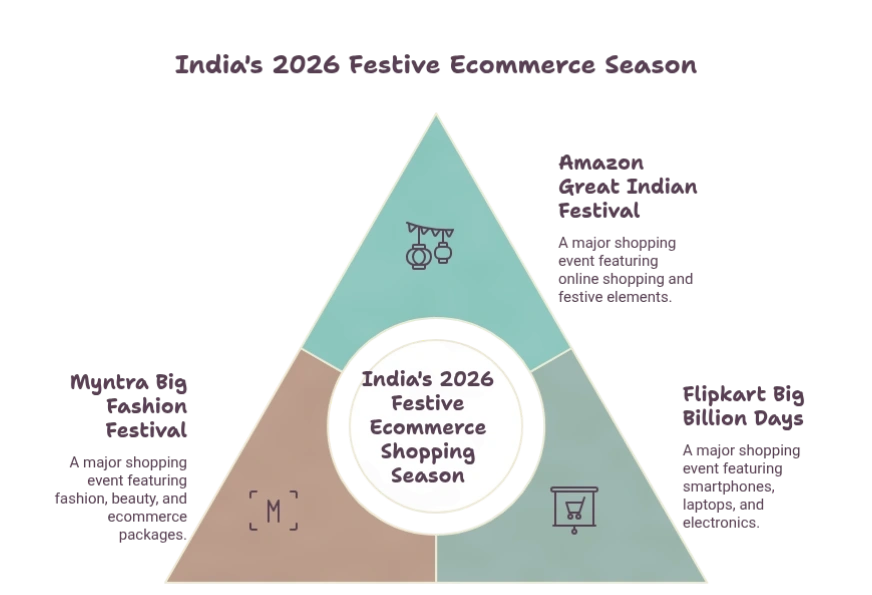
The familiar names are back: Flipkart Big Billion Days, Amazon Great Indian Festival and Myntra Big Fashion Festival. But the bigger story isn’t simply about how many discounts shoppers will see on their screens.
The way Indians shop online is changing.
People are buying more frequently, shopping from smaller cities, exploring categories beyond smartphones and televisions, using AI to research products, looking for faster delivery and increasingly combining discounts with bank offers, exchange benefits and flexible payment options.
At the same time, sellers are preparing for a very different challenge. A successful festive sale can mean a sudden jump in orders, which puts pressure on inventory, picking, packing, shipping and warehouse teams.
Here’s what to expect from the major 2026 festive sales and, more importantly, what this year’s shopping season tells us about the changing Indian e-commerce market.
2026 Festive Sale Calendar: Amazon, Flipkart and Myntra
The three major shopping events are arriving within a very short window.
| Platform | Sale | 2026 schedule |
|---|---|---|
| Amazon | Great Indian Festival | Starts October 8 |
| Flipkart | Big Billion Days | Early access October 8; main sale October 9 |
| Myntra | Big Fashion Festival | Starts October 8 |
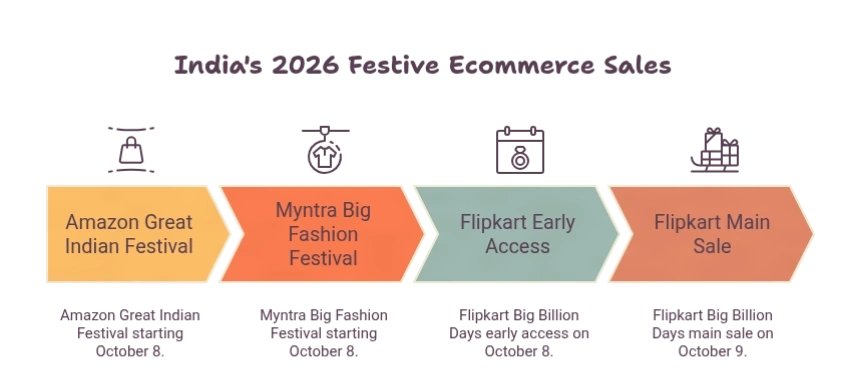
Amazon has officially confirmed that the Great Indian Festival 2026 begins on October 8, with early deals already available on Amazon.in.
Flipkart has announced early access to Big Billion Days from October 8, followed by the main shopping event from October 9.
Myntra’s latest Big Fashion Festival campaign also confirms that the fashion event goes live on October 8, with more than eight million styles being promoted as part of the festival.
That close timing is worth noting. For shoppers, it means several major sale events will compete for attention almost simultaneously. For sellers, it means the festive rush can arrive very quickly.
Festive Shopping in 2026 Is Bigger Than Electronics
For years, festive e-commerce in India was strongly associated with smartphones, televisions, laptops and large appliances.
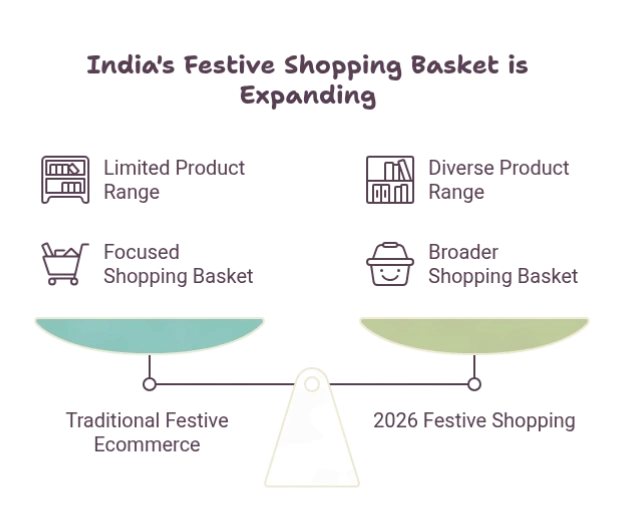
Those categories are still extremely important. But the shopping basket is getting wider.
Research from Redseer estimates that India’s online retail market will cross $90 billion in 2026, with the market expected to grow by roughly 22–24% during the year. Redseer also expects festive 2026 online retail growth of around 25%, with grocery, beauty, personal care, fashion and other everyday categories playing a larger role.
Flipkart’s current festive-season observations point in the same direction. The company has reported around 50% year-on-year growth in FMCG and nearly 60% growth in beauty, while healthcare, baby care and fitness are also gaining attention, particularly outside metropolitan markets.
This is an important shift.
A festive sale is no longer only the time when someone waits for the price of a smartphone or television to drop. It is increasingly becoming an opportunity to buy clothes, beauty products, groceries, home products, personal-care items and other things that households need anyway.
Premium Products Are Finding Their Way Into Sale Carts
Another interesting change is the rise of premium shopping.
A sale does not necessarily mean consumers are looking only for the cheapest product available. Discounts, exchange offers, EMI options and bank promotions can make a more expensive product feel achievable.
Amazon’s 2025 Great Indian Festival provides a good indication of this behaviour. Amazon reported that smartphones priced above ₹30,000 grew 30% during the event, with 65% of that contribution coming from Tier-2 and Tier-3 cities. Premium apparel also grew strongly, while premium watches and other higher-value categories saw increased demand.
The same trend was visible in televisions. Amazon reported growth in larger screen sizes and particularly strong growth in QLED and Mini-LED televisions during the 2025 festive period.
So the question during a festive sale is increasingly not just:
“What is the cheapest deal?”
It can also be:
“What can I now afford because the overall value has improved?”
That distinction matters for both shoppers and brands.
Tier-2 and Tier-3 Cities Are Central to the Festive Story
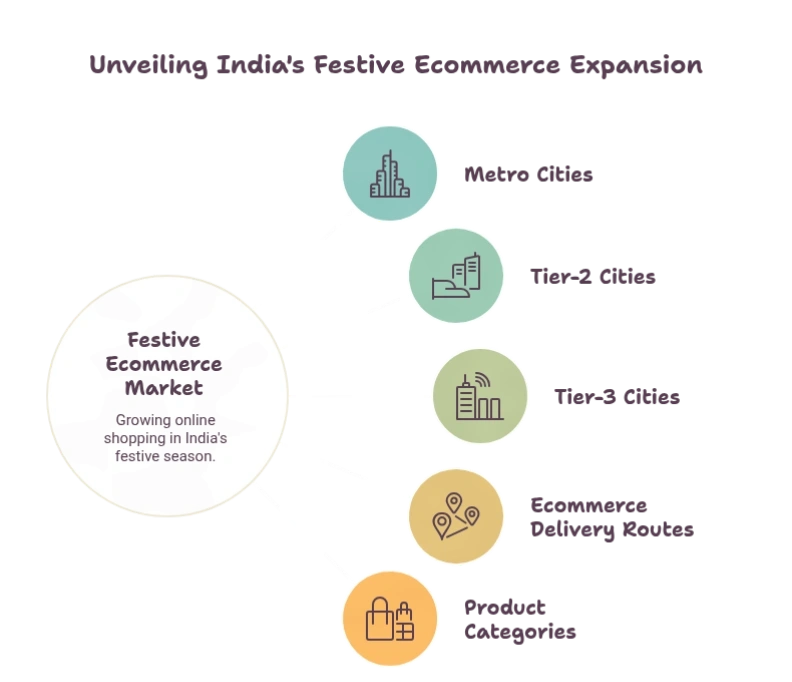
One of the biggest changes in Indian e-commerce has been the growing importance of consumers outside the largest metropolitan cities.
Amazon reported that 70% of customer visits during its 2025 Great Indian Festival came from Tier-2 and Tier-3 cities.
Flipkart has similarly highlighted the importance of smaller cities and towns in its festive business. The company’s supply-chain expansion for 2026 includes more than 900 new festive delivery hubs, while 60% of its newly created festive employment opportunities are in last-mile delivery. Flipkart specifically linked this expansion to rising demand across Tier-2 and Tier-3 markets as well as the growth of Flipkart Minutes.
This changes the picture of the typical festive online shopper.
The festive customer is no longer concentrated in Mumbai, Delhi, Bengaluru, Hyderabad or other large metros. E-commerce has become part of shopping behaviour across a much wider part of India.
For sellers, that creates a much larger opportunity. It also means that product availability, reliable delivery and an efficient fulfilment process matter across a much broader geographic market.
AI Is Becoming Part of the Shopping Journey
Perhaps the most interesting new development in 2026 is happening before the customer even reaches the checkout page.
AI is becoming a shopping research tool.
According to Datum Intelligence’s 2026 festive research, 51% of online shoppers surveyed had used AI chatbots to research an online purchase during the previous three months, while 49% had used marketplace AI assistants. Comparison websites and price trackers were also commonly used during product research.
That means the traditional shopping journey is changing.
It used to look something like:
Open marketplace → search for product → compare prices → buy
Increasingly, it can look more like:
See a product → ask AI about alternatives → compare products → check prices → research reviews → watch for an offer → purchase
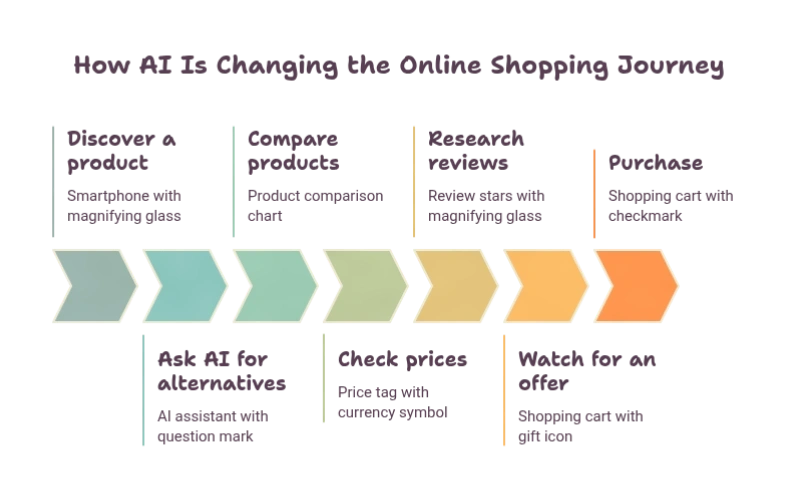
Amazon is already bringing AI into this process. Its shopping experience includes tools such as Rufus, which can help customers research products, compare options and make purchase decisions.
For shoppers, that can make the research process easier.
For sellers and brands, it means product discovery is becoming more complicated. Winning a sale is not only about appearing in a search result. Product information, reviews, pricing, availability and overall value can all influence the decision.
Quick Delivery Is Raising Customer Expectations
The festive season is also happening at a time when Indian consumers have become accustomed to faster delivery.
Quick commerce is no longer limited to a small group of grocery purchases. It is becoming another layer of India’s online retail ecosystem.
Redseer’s 2026 online retail research identifies quick commerce as one of the structural growth drivers of the market rather than simply a temporary trend.
Amazon is also expanding Amazon Now, its faster-delivery service, into more Indian cities. Amazon says the service is being expanded to more than 300 cities, reflecting the broader push toward faster fulfilment.
Flipkart is making a similar investment through Flipkart Minutes. Its festive-season expansion is accompanied by hundreds of new delivery hubs and additional last-mile capacity.
The result is a simple change in customer expectations:
“When will my order arrive?” is becoming almost as important as “How much does it cost?”
During a major sale, that expectation becomes even stronger.
Flipkart Big Billion Days 2026: What to Expect
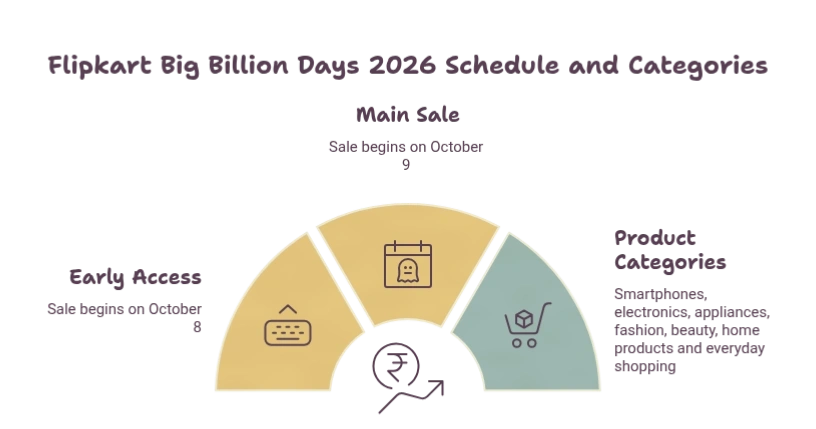
Flipkart’s Big Billion Days 2026 begins with early access on October 8, followed by the main sale on October 9. The event is being promoted through Flipkart’s new “Luck Badal Sakta Hai, Yahan Kuch Bhi Ho Sakta Hai” campaign.
As usual, the event covers a broad range of categories, including smartphones, electronics, appliances, fashion, beauty, home products and everyday purchases.
But BBD 2026 is arriving in a market where shoppers are no longer focused exclusively on big-ticket electronics.
Flipkart’s current festive observations show stronger demand in FMCG, beauty and personal care, healthcare and other everyday categories. The company has also pointed to the growing role of Gen Z, social-media influence and D2C brands in categories such as beauty and FMCG.
For shoppers, that means BBD is likely to feel increasingly like a broad shopping festival rather than an electronics-only event.
For sellers, it means preparing for demand across a wider assortment.
Amazon Great Indian Festival 2026: What to Expect
Amazon’s Great Indian Festival 2026 begins October 8, and early deals are already live.
Amazon is promoting offers across smartphones, electronics, fashion, beauty, home and kitchen, appliances, everyday essentials and other categories. The company has also announced an instant discount for eligible SBI card and EMI transactions, alongside additional benefits for Prime members.
One of the more interesting aspects of this year’s event is the technology behind the shopping experience.
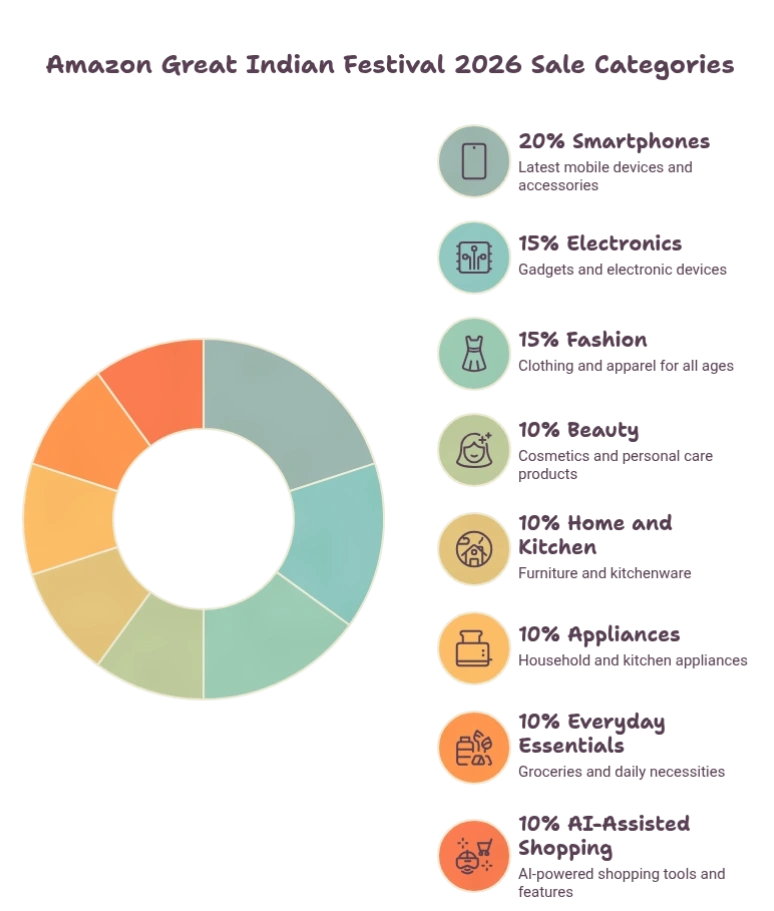
Amazon is putting greater emphasis on AI-assisted shopping, while also expanding its fulfilment infrastructure ahead of the festive period.
Amazon India recently announced its largest operations-network expansion for the festive season, including 20 new fulfilment centres, six new sort centres and 150 new last-mile delivery stations. The company says this expansion will increase storage capacity by 50% to 64 million cubic feet.
That investment says something about the scale of the season.
Behind every sale banner and discount notification is a very large physical operation involving inventory, warehouses, sorting, transportation and delivery.
Myntra Big Fashion Festival 2026: Fashion Takes Centre Stage
While Amazon and Flipkart cover a broad range of categories, Myntra Big Fashion Festival has a different focus.
Fashion, footwear, beauty and lifestyle remain at the heart of the event.
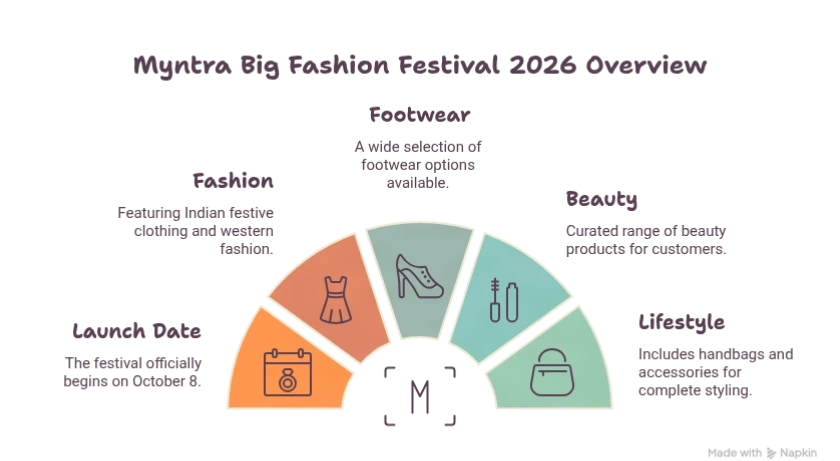
Myntra’s 2026 BFF campaign features Alia Bhatt and Ranbir Kapoor and is scheduled to go live on October 8. The campaign is promoting more than eight million styles, highlighting the enormous breadth of fashion and lifestyle products available during the event.
The importance of Myntra’s event goes beyond metropolitan fashion shoppers.
The 2025 BFF showed strong participation from non-metro markets, demonstrating that fashion e-commerce is increasingly reaching customers well beyond India’s largest cities.
That matters because festive fashion is not limited to one type of customer. Ethnic wear, wedding shopping, footwear, beauty, sportswear and everyday fashion all become relevant as the country moves toward the festive and wedding season.
Flipkart vs Amazon vs Myntra: What Is Different?
There is no single “best” sale for everyone. Each platform serves a somewhat different shopping mission.
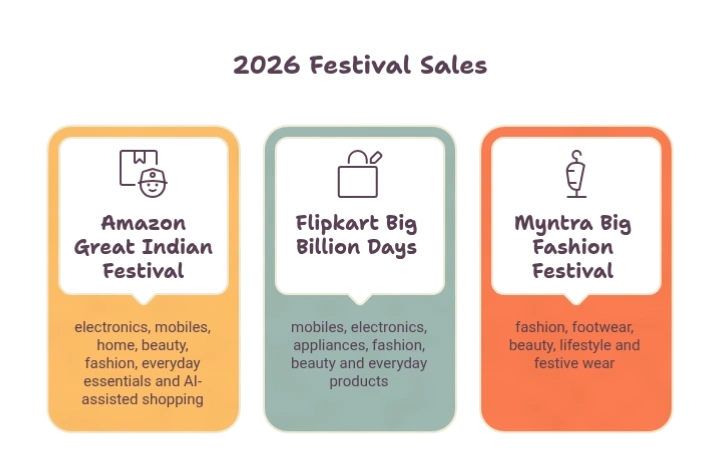
Flipkart Big Billion Days is a broad marketplace event spanning electronics, mobiles, appliances, fashion, beauty and everyday categories.
Amazon Great Indian Festival combines a similarly broad product selection with an increasingly technology-driven shopping experience, including AI-assisted product discovery and a large fulfilment network.
Myntra Big Fashion Festival is much more focused on fashion, beauty and lifestyle, making it particularly relevant for shoppers preparing for the festive and wedding season.
For many consumers, the reality will not be choosing only one.
Someone might compare smartphones on Flipkart and Amazon, then move to Myntra for festive clothing. Another shopper may buy groceries or household products during the same period while looking for fashion and beauty offers.
The 2026 festive season is therefore less about one marketplace winning the entire shopping basket and more about consumers spreading their purchases across different platforms.
How Shoppers Can Plan for the 2026 Sale Season
With Amazon, Flipkart and Myntra sales arriving within days of each other, it can be tempting to start adding products to wishlists and wait for the biggest discount to appear. A little planning can make the sale period much more useful.
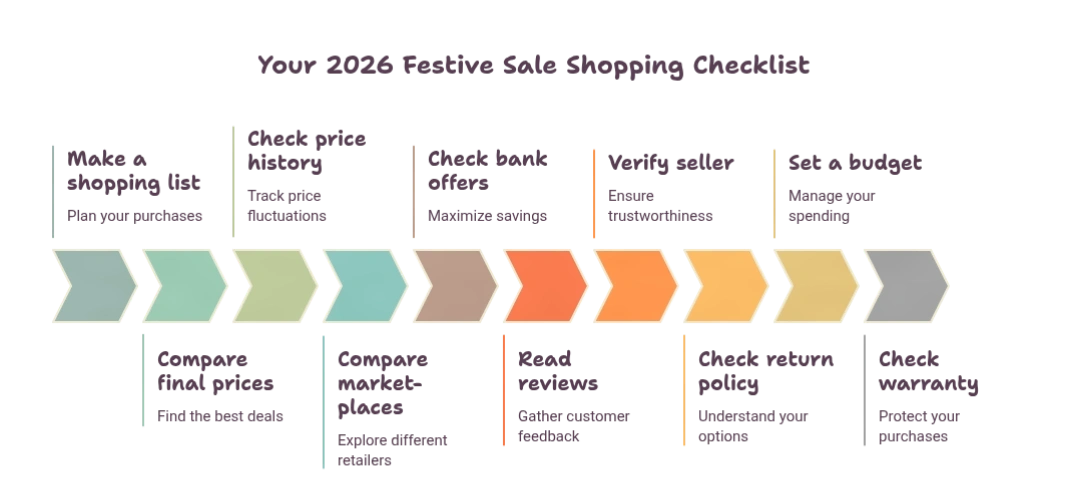
Make a list before the sale starts
Start with what you actually need. Whether it is a smartphone, laptop, home appliance, festive clothing, footwear or everyday essentials, write down the products you are considering before the sale begins.
Compare the final price, not just the discount
Compare the actual selling price and check bank discounts, EMI offers, exchange benefits, cashback, coupons, delivery charges and warranty details.
Add important products to your wishlist early
If you already know what you want, add it to your wishlist or shopping list before the sale. This makes it easier to track price and availability when the sale begins.
Check prices before the sale
Keep an eye on the price in the days leading up to the sale rather than judging the offer only by the MRP and discount percentage displayed on the sale page.
Decide where you want to shop
You do not necessarily have to buy everything from one marketplace. Compare the product, price, payment offer, delivery and return conditions that apply to the purchase you are making.
Use AI and comparison tools for research
AI assistants can help shoppers compare specifications, understand product differences and narrow down choices. For expensive products, verify product details, reviews, warranty information and seller details before buying.
Set a budget before the sale begins
Festive sales can encourage impulse purchases. Setting a budget beforehand can help keep the focus on planned purchases.
A simple way to classify purchases:
- Need now — products you already planned to buy.
- Useful if discounted — products you would buy if the price reaches your target.
- Impulse — products you did not plan to buy but may purchase because of the sale.
Check return, replacement and warranty policies
Before buying, especially expensive electronics, appliances, fashion or beauty products, check the applicable return or replacement policy, warranty coverage and seller information.
Keep payment offers ready
If you are planning a major purchase, check which payment method provides the applicable offer before the sale starts. Bank discounts, EMI offers and cashback can change the effective purchase price.
A simple sale-day checklist
- Is this something I actually planned to buy?
- Did I compare the final price?
- Is the seller reliable?
- Have I checked reviews?
- Does the product have the warranty I need?
- Are there exchange or return restrictions?
- Does a bank or payment offer apply?
- Is the delivery date suitable?
- Am I staying within my budget?
What the 2026 Sale Season Means for Sellers
For shoppers, a sale is usually about finding a product at a better price.
For sellers, the sale starts long before the customer clicks “Buy Now.”
The first challenge is inventory.
Fast-moving SKUs can suddenly move much faster than they do on normal days. A product that usually sells 20 units a day may suddenly become one of the most frequently ordered items in a seller’s catalogue.
Then comes the operational chain:
Order received → picking → verification → invoice and shipping documents → packing → dispatch
Every step has to keep moving.
If orders increase five times but the warehouse continues processing them one by one in exactly the same way, the additional demand can quickly become an operational bottleneck.

This is particularly important for sellers managing multiple marketplaces.
A festive day could mean orders coming from Amazon, Flipkart and Myntra at the same time. Each marketplace may have different order information, shipping requirements and processing timelines.
The challenge is no longer simply generating sales.
It is processing those sales accurately and on time.
Why SKU-Wise Processing Becomes More Important During Sales
Consider a simple example.
A seller normally receives 200 orders a day.
During a major sale, that number rises to 1,000.
If the team processes every order individually, warehouse staff may repeatedly walk to the same shelves to pick the same products.
Instead, a seller can organize the workload around SKUs.
Suppose 100 of those orders contain the same black T-shirt in size M.
Rather than finding that product 100 separate times, the warehouse can identify the repeated SKU, pick the required quantity together, verify it and then continue with the packing workflow.
The same principle can be applied to other high-volume products.
This does not eliminate the need for checking individual orders. It simply organizes the work in a way that can reduce unnecessary movement and repetition.
During sale periods, those small operational improvements can make a meaningful difference.
How Sellers Can Prepare for the 2026 Festive Sales
A few practical preparations can make the sale period much easier to manage.
Check fast-moving inventory
Identify products that are likely to receive higher demand and make sure stock levels are visible before the sale begins.
Prepare packaging material early
Running out of boxes, mailers, tape, labels or other packing supplies during a sale is an avoidable problem.
Identify high-volume SKUs
Look at previous sales and current demand to determine which products are likely to dominate the order volume.
Organize the warehouse
Products that sell frequently should be easy for the packing team to locate.
Plan for document printing
Invoices, shipping labels and other documents can become a significant part of the workload when order volume rises.
Create a batch-processing workflow
Where the order volume makes it practical, group work around repeated SKUs or batches instead of treating every order as an entirely separate task.
Keep dispatch deadlines visible
A large order count is useful only if those orders can move through the fulfilment process on time.
Prepare additional manpower
The busiest part of a sale may not be order acquisition. It may be picking, packing and dispatch.
The Real Challenge of a Big Sale Starts After the Order Arrives
The festive shopping season is becoming faster, broader and more competitive.
Consumers have more choices than ever. They can research products with AI, compare prices, use bank offers, choose premium products, shop from smaller cities and increasingly expect fast delivery.
For sellers, that means preparation has to go beyond discounts and advertising.
Inventory needs to be ready.
The warehouse needs to be organized.
High-volume SKUs need to be easy to identify.
Orders need to move through picking and verification efficiently.
Invoices and shipping documents need to be generated without creating a new bottleneck.
And packing teams need a process that can handle the sudden increase in workload.
This is where structured order-processing workflows become especially valuable. Platforms such as HappySellers can help sellers bring marketplace orders into a more organized processing workflow, making it easier to work with batches, SKUs and shipping documents instead of relying entirely on repetitive manual processing.
The 2026 Festive Season Is About More Than Discounts
The biggest story of India’s 2026 festive shopping season may not be the size of any individual discount.
It is the way shopping itself is changing.
Online retail is moving beyond smartphones and televisions. Tier-2 and Tier-3 cities are playing a larger role. Premium products are finding more buyers. Fashion, beauty, grocery and everyday categories are becoming more important. AI is entering product research. Quick commerce is raising expectations around delivery speed.
And behind all of this, sellers are dealing with increasingly complex order volumes.
The upcoming Amazon Great Indian Festival, Flipkart Big Billion Days and Myntra Big Fashion Festival will be some of the biggest shopping events of the year. But for shoppers, the experience starts before the sale opens and, for sellers, the work continues long after the customer places the order.
That is perhaps the biggest change in festive e-commerce in 2026:
The sale is no longer just a moment when prices drop. It has become a complete shopping and fulfilment ecosystem.

Frequently Asked Questions
When does Amazon Great Indian Festival 2026 start?
Amazon has announced that the Great Indian Festival 2026 starts on October 8, 2026.
When does Flipkart Big Billion Days 2026 start?
Flipkart has announced early access from October 8, 2026, with general public access beginning October 9, 2026.
When does Myntra Big Fashion Festival 2026 start?
The supplied article states that Myntra Big Fashion Festival 2026 goes live on October 8, 2026.
What categories are important during the 2026 festive sales?
Electronics remain important, while the article also highlights fashion, beauty, grocery, FMCG, personal care, home products, healthcare, fitness and other everyday categories.
How should shoppers prepare for the 2026 sales?
Make a shopping list, compare final prices, check prices before the sale, review payment offers, verify seller and warranty details, and set a budget before shopping.
Why do festive sales create operational pressure for sellers?
Higher order volumes can put pressure on inventory, picking, verification, invoices and shipping documents, packing and dispatch, especially for sellers handling multiple marketplaces.
What is SKU-wise processing?
SKU-wise processing organizes warehouse work around repeated products. For example, if many orders contain the same SKU, a team can identify and pick the required quantity together before verifying and continuing with order-level packing.
Resources
- Amazon India — Great Indian Festival 2026 dates and festive operations
- Amazon India — Great Indian Festival 2026 early deals and AI-powered shopping
- Flipkart — Big Billion Days 2026 sale information
- Flipkart Stories — 2026 festive announcements and supply-chain expansion
- Redseer Strategy Consultants — India Online Retail 2026
- Myntra — official shopping platform
Sale dates and market figures can change as platforms publish new information. Check the linked official source before publishing time-sensitive statements or updating the article.